Yuri da Silva Villas Boas
Applied cryptographer · coercion-resistant Bitcoin self-custody
author of BIP-450 · Great Wall
Self-custody advice tells you to hide, deny, and keep a decoy. All three are bets on what the attacker believes. None of them has ever been assessed as what it is: a security mechanism whose entire strength depends on the adversary's ignorance.
Papers
Both open access, both free, neither behind a signup. Each DOI resolves to the current version.
The Deadly Race
10.5281/zenodo.22018891
Any custody scheme which, through a wrench attack, yields a feasible-but-unfinished
path to the funds turns you into racer for the same balance, hence manufacturing
an incentive for killing you. The paper establishes a design criterion
you can apply to your own setup: the attack must clearly succeed or clearly
fail, never become a race.
The Denial Spiral
10.5281/zenodo.22778480
Where "Don't tell anyone you own Bitcoin." is commonplace, anyone's denial,
truthfull or otherwise becomes utterly unconvincing. Paper dives in community's
crisis of prolonged wrench attacks and its recalcitrance on methods reliant on
ignorance, stupidity and gullibility of wrench attackers.
Both build on Jameson Lopp's public registry of physical attacks.
Standards
BIP-450 — Formosa
A forwards- and backwards-compatible expansion of BIP-39 that maps seed entropy onto grammatical sentences instead of word lists. In the Bitcoin standards repository. Reference implementation.
A forwards- and backwards-compatible expansion of BIP-39 that maps seed entropy onto grammatical sentences instead of word lists. In the Bitcoin standards repository. Reference implementation.
Projects
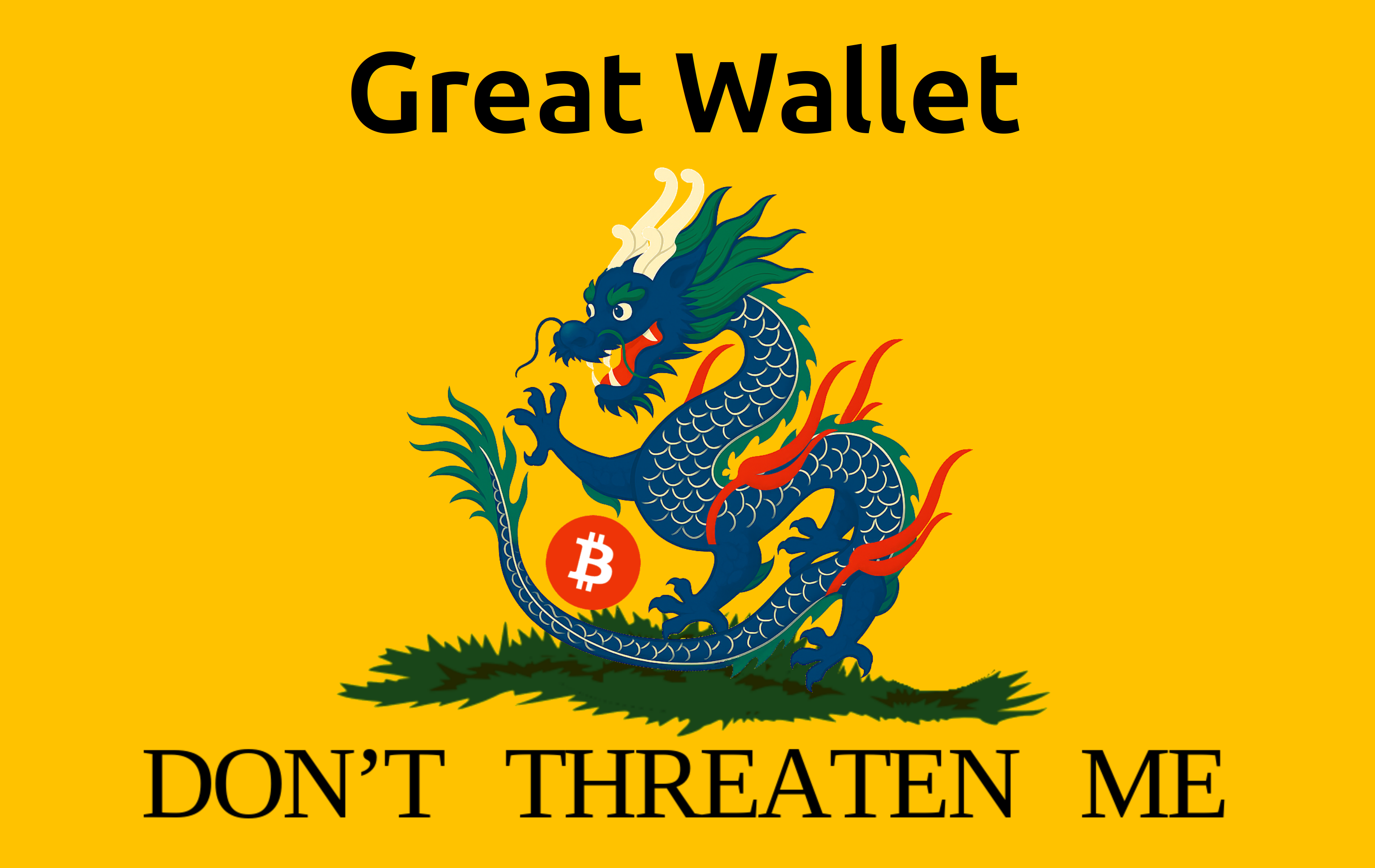
Great Wall
Coercion-resistant self-custody through Tacit Knowledge-Based Authentication: memory-held entropy navigated against a user-specific perturbation of a fractal. Kerckhoffian and coercion-resistant at the same time. The implementation is a prototype. Do not put savings behind it yet.
Coercion-resistant self-custody through Tacit Knowledge-Based Authentication: memory-held entropy navigated against a user-specific perturbation of a fractal. Kerckhoffian and coercion-resistant at the same time. The implementation is a prototype. Do not put savings behind it yet.
BTC-D20
A printable kit for generating a BIP-39 seed with a 20-sided die, in four languages. Entropy you watch happen, no electronic RNG anywhere. Finished, and needs nothing to keep working.
A printable kit for generating a BIP-39 seed with a 20-sided die, in four languages. Entropy you watch happen, no electronic RNG anywhere. Finished, and needs nothing to keep working.
Research
The threat model, the cost analysis, and the registry coding behind the papers.
The threat model, the cost analysis, and the registry coding behind the papers.
Self-custody audit
I read the arrangement you already have — hardware wallet, passphrase, multisig, decoy, inheritance plan, whatever there is — and answer four questions in a closed report.
- Is your security based on a secret trick? Does it depend on the attacker not knowing what you do, and how you do it?
- Once your devices and secrets are seized, could the attacker spend right away, or only eventually? "Eventually" means you are still a competing racer for the same balance.
- Is your custody strictly individual? Can anyone else do something that stops you reaching your own coins?
- Does it depend on particular objects in particular places? And do you own those places?
I never ask for your seed, your balances, your addresses or where you live. The audit works on the shape of your arrangement, not its contents. An auditor of coercion resistance who collected holder data would be assembling exactly the list the papers condemn, and data that was never with me cannot be seized from me.
What I will not do is build a decoy with denial training. It is the most requested service and the only one I refuse, for the whole argument of The Denial Spiral.
The four questions in full, and what the report contains →
The course
Five live sessions on coercion-resistant self-custody, cohorts of 6 to 12, every session ending at a keyboard. The textbook, slides and syllabus are already free and public; what's sold is the room. It's a pilot, and the first cohort's job is partly to break it.
The five sessions, who it's for, and how to join →
Support
Great Wall, BTC-D20, BIP-450 and the papers are MIT or Apache-2.0, and that does not change: no "pro" version, no feature unlocked by payment, no priority queue for donors. What is sold is time, not software.
Support takes Lightning and
on-chain, with no signup and nothing expected in return. What has actually
shipped is logged and dated in git history that anyone can audit:
DELIVERED.md.
Selected writing
The series — posts on coercion resistance and the physical-attack registry, each in several languages, drafted in the open at great-wall-posts.
- Esconder seu bitcoin ainda protege você? — Bitcoin Block, 2026 (pt-BR)
- Introducing the SRVB cryptosystem — Toptal
- Formosa: crypto wallet management — Toptal
- MSc thesis — UFSC
- IEEE Xplore 9092355 · 9239493 — conference papers