

Anyone who has sat through a protocol design course met Kerckhoffs's principle in about the second week. It's the one everybody can recite. And this community, which will argue for six hours about whether a wallet's RNG is trustworthy, ships physical-coercion defenses built on security through obscurity, and they fail on the first page of the manual.
Not subtly. The manuals say so themselves, and this piece is mostly just quoting them.
What Kerckhoffs actually says
Put the jargon aside. A system has to stay secure when the attacker knows exactly how it works. Everything except the key is public: the design, the software, the procedure, the fact that the procedure exists. You judge a design by how it performs against someone who has read the same documentation you have.
That isn't pessimism about attackers. It's an admission about publication. The moment a defense ships to consumers, its description is in a support article, in the attacker's language, indexed, free.
Security through obscurity has a catalog number
The family of tactics that breaks this rule has a name and a filing number. Reliance on Security Through Obscurity, cataloged as CWE-656. In any other software domain that entry is a defect you fix. In bitcoin custody it's the consensus recommendation.
And this paradigm, which protocol design calls obscurity, is inherently condescending. It assumes the thief isn't mentally capable of reading the same manuals, watching the same tutorials and taking the same courses as his victims. If you can learn a procedure on the internet, so can a thief, and he'll certainly know the procedure exists.
Aim that at the assumption, not at anyone holding it. The people shipping these features are careful engineers who got one premise wrong. It happens to be the load-bearing one.
Three bets on what an attacker will believe
The standing counsel comes in three parts: hold quietly, deny if asked, keep something small to hand over. Restate them without the reassurance and they're three wagers on an adversary's state of mind. Not three controls. Three guesses about what someone else will think, made by the person with the least ability to check.
A control works when the attacker knows about it. That's the whole distinction, and every mechanism below fails on that side of it.
The class, in the vendors' own words
I'm going to quote documentation rather than characterize it, because the classification does the work and characterizing it invites an argument about motive that nobody needs.
The erase PIN, and the backup it assumes
Blockstream's Jade ships an alternate PIN that, in the help center's words, "automatically delete[s] the encrypted wallet information from Jade if entered". It's presented as "especially useful in the event of a physical threat, as you can provide this PIN to an attacker". Enter it and the device reports only "Internal Error", so the erasure reads as a malfunction rather than a decision.
Credit where it's due: the erasure itself is real, instant, and can't be interrupted. There's no race to win.
Now read the next warning on the same page. Afterwards "there is no way to regain access to your funds except by restoring using your recovery phrase", so the holder should "make sure you have a backup before proceeding".
The feature presupposes a backup. A holder who follows the documentation has one; a holder who doesn't has destroyed their own savings under pressure. So what the erasure removes is not the secret. It removes the device path to the secret, and leaves standing the path that runs through the person's memory of where the backup is.
The erasure deletes the route that required hurting nobody, and keeps the one that doesn't.
Coldcard documents the regress
You don't have to derive the next step. A vendor published it.
Coldcard ships trick PINs, including a duress wallet described as "a personal safety feature… If you must reveal a PIN under duress, give the duress PIN instead of your Main PIN". Ordinary decoy logic. The firmware documentation then considers what happens when the decoy isn't believed, and its advice is to escalate: "you may be asked what the actual duress PIN is, while under duress. We suggest providing the 'brickme' PIN in that case."
That's a manufacturer contemplating an attacker who knows decoys exist, and recommending an irreversible erasure performed with the victim still in the room, still breathing, still able to be asked where the backup is.
Two further admissions on the same page are worth quoting because vendors rarely make them. The first concedes the decoy is distinguishable: "if you are somehow facing an attacker who is willing to verify he has the real main PIN, it's possible that careful analysis of system responses will imply he's working with the duress PIN." The remedy offered isn't a repair. It's a request: "if you discover any sequences that reveal this easily, please tell us and we'll see if we can cover them up better."
Obscurity stated as a maintenance program. What's being defended isn't that the decoy is indistinguishable, but that nobody has published how to distinguish it yet. A scheme whose security is the current state of the disclosure backlog is a scheme you can't invoke in the room, because you have no idea what the man in front of you has read.
The second admission is the denial itself, offered where bricking is unpalatable: "alternatively, you can say you set the duress PIN once, but have since forgotten it."
You cannot prove you forgot. That's the whole of the companion paper in five words, and here it is as published guidance. The vendor enumerated the branches and found a bluff on each one.
What each vendor actually claims
This matters and it's where most criticism of this kind goes wrong. The three firms don't make the same claims, and a vendor who ships a mechanism without claiming it defeats coercion hasn't made the error this piece is about.
Blockstream markets the erasure for physical threat, and claims nothing of the sort for its passphrase wallets. The duress framing of passphrase decoys is the community's invention, not the manufacturer's. Coldcard markets both halves. Trezor is Blockstream's mirror image: its passphrase wallets are sold on deniability, while its wipe code, which the vendor itself calls a "self-destruct" PIN and which erases the recovery seed, is documented with no mention of duress, coercion or physical threat at all.
Trezor is also the one that was asked, in January 2022, to make the wipe concealable — a user-defined message on entry, so an erasure could pass as a hardware fault. The request was closed as not planned. The device still announces the wipe plainly.
That refusal is the most interesting document in the whole class. It shows the "Internal Error" disguise isn't intrinsic to erasure at all. It's a presentation choice: one vendor built it, another was asked for it directly and declined.
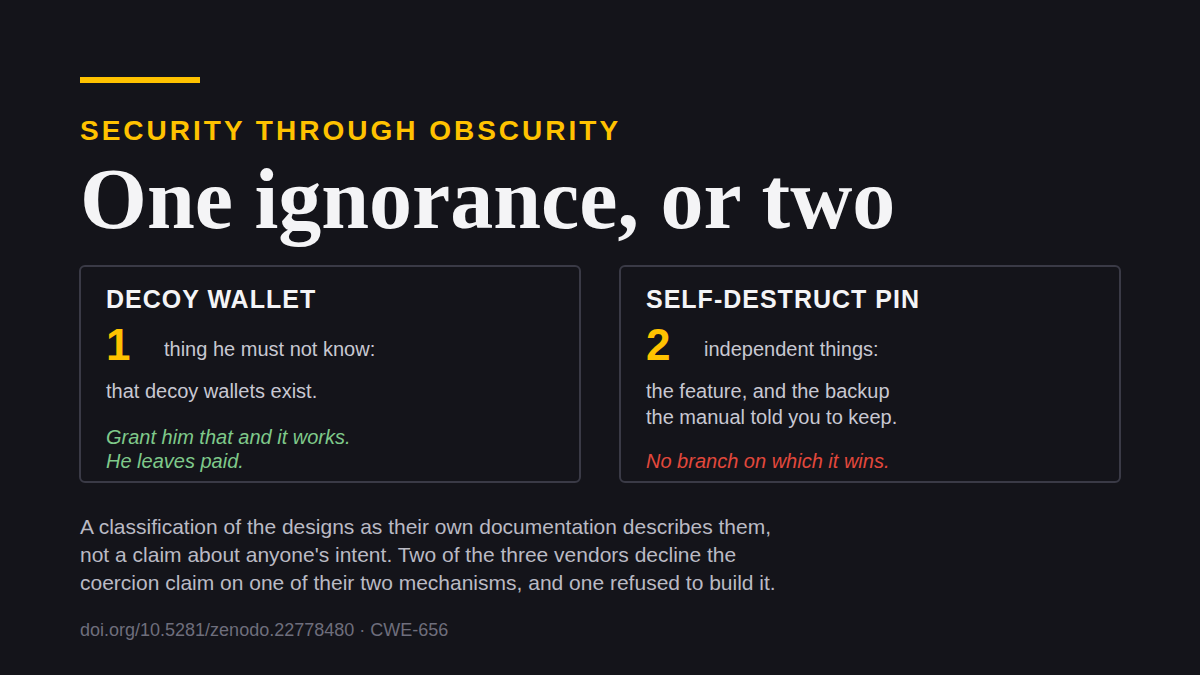
One ignorance, or two
There's a clean way to rank these, and it isn't by how likely the attacker is to be ignorant. It's by how many separate things he has to be ignorant of.
A decoy needs one. He must not know decoys exist. Grant him that and the decoy genuinely works: he leaves with a plausible balance and a story that closes.
A self-destruct needs two, and they're independent. He must not know the feature exists, so the failure reads as breakage. And he must not reason his way to a backup, which the manual told the holder to keep. The second doesn't follow from the first. "This device is broken" has never implied "this person has no bitcoin". It implies the instrument is broken, and the natural next question is where you keep the backup, asked of someone still standing there.
So against an informed attacker the self-destruct fails for the ordinary Kerckhoffs reason, and against an ignorant one it fails anyway, because the belief it manufactures doesn't end the encounter. It's the one obscure scheme with no branch on which it wins.
There's a quieter version of the same failure. Sparrow's FAQ documents a flag for storing wallet data on removable media, noting that it "allows you to store all Sparrow data on removable media making for more plausible deniability". Sparrow's own best-practice page keeps the seed words backed up separately, "ideally in a different location". So an attacker coerces the seed backup, loads it into his own wallet, and never touches the concealed medium. A decoy at least stands between him and the coins. This stands nowhere near them, and what it adds is the confidence to make a denial.
Eighty-eight people, twelve cases
The class assumes an adversary the record says doesn't exist.
French prosecutors have charged 88 people across a dozen crypto-linked kidnapping and extortion cases, which is a point-in-time count from an active series of prosecutions rather than a closed tally. CertiK's count for the first half of 2026 has home invasions going from 1 to 20 out of 52 incidents year on year, which is one firm's half-year sample rather than the public registry, so read the direction and not the decimal.
Whatever the exact figures settle at, they describe organized crews with reconnaissance and victim selection running off leaked databases. Not opportunists who can't read a support page in the language it was written in.
The backfire
Obscurity isn't only ineffective. Sold at scale, it's self-defeating, and the people it hurts most never bought it.
The decoy isn't just a tolerated practice. It's a product and a curriculum. A Spanish-language self-custody consultancy lists among its paid tiers "Passphrase (tu bóveda señuelo) — Billetera señuelo + billetera real. Protección ante coacción/coerción": a decoy wallet marketed, in as many words, as protection against coercion. Published guides coach the performance. One has the holder keep a small balance on the bare seed as what you'd hand over under physical coercion, adding that "for this to work, the decoy balance must be believable — enough to look like a real wallet, not enough to devastate you if lost."
Read that as a training objective and the problem is visible. A decoy only needs to be believable to an attacker who might disbelieve it, and the advice goes quiet on what happens when he does, which is the entire question. Security through obscurity is being sold here as though it were a control, priced and taught.
Denial is a commons, and it is being drained
Publicized training raises the prior that a fluent denial was rehearsed. Once an attacker knows credibility is taught and sold, fluency stops being evidence of truth and starts being evidence of coaching. The remedy degrades the thing it sells.
And it degrades it for everyone. A holder who never trained, who is telling the plain truth, now denies into an attacker who discounts fluent denials generally. So does someone who holds no bitcoin at all. The full development of that is The Denial Spiral, and it's the reason this series treats obscurity as a public health problem rather than a personal one.
Hiding needs somewhere to hide. What a discreet holder disappears into is the enormous crowd of people who visibly don't hold bitcoin, and that only works while the crowd is mostly genuine. Coach enough people to present as ordinary and ordinary stops carrying information, because the attacker isn't sorting holders from non-holders any more. If everyone is a needle, there is no hay.

Structural, not measured. Nobody has counted how many holders practice discretion, and by mechanism 1 nobody can: obscurity doesn't advertise itself. The claim is about what happens to the crowd as coaching spreads, not about where the crowd is today.
A public design makes an ordinary denial more credible
One last inversion, and it's the part I find genuinely surprising.
An obscure defense asks the attacker to believe a claim, against his incentive to disbelieve it and with no way for either of you to settle it. A publicly specified design changes what making that claim costs. An attacker who credits that effective mechanisms are in circulation is crediting that lying isn't the victim's only available tool, and a holder with real alternatives has less reason to reach for a lie.
So a Kerckhoffs-clean design improves the standing of exactly those obscure denials it was built to make unnecessary. Security through obscurity stays unsound as a primary defense. It isn't indifferent which design it accompanies.
The classification, the vendor documentation and the commons argument are developed in The Denial Spiral , open access, no signup. Its companion, The Deadly Race, covers what happens once the attacker is already in the room: a seizure that leaves a feasible-but-unfinished path turns a robbery into a race, and prices your elimination.
Every vendor quotation above is from public documentation, linked in the paper. If I've misread a feature or a page has changed, tell me and I'll correct it in public.
If this was worth your time. Send it to someone who ships a duress PIN. A ⭐ on Great Wall, the research or these posts costs nothing and makes the work easier to find. And if you want to fund it, support takes ⚡ Lightning and on-chain, no signup, no tiers, nothing expected back.