

If you hold bitcoin in France and you declare it, you're in a database. In June 2025 an employee of the tax administration was taken into custody, accused of querying that database for organized crime. Investigators reported the queries covered, among others, people who had declared gains in cryptocurrency.
France is also where the wrench attack has become a national story, and this post is about the connection between those two facts.
A database, queried
What the reporting says
The reporting describes an agent in Île-de-France consulting Mira, an internal tax system holding sensitive files, with no professional reason to be in it. The results, addresses and financial situations, allegedly went to a handler connected to organized crime. Payment reportedly came by Western Union.
She's been in custody since 30 June 2025, under investigation for criminal association and complicity in violence against a prison officer. At a hearing she reportedly admitted the facts and declined to say who was giving the orders. The proceedings are open and nothing here is a verdict.
The part that should bother you isn't any of that.
How it surfaced, and why that is the worst part
The case came out because one of the addresses she passed on belonged to a prison officer, and that officer was violently attacked. Somebody pulled that thread and found the rest at the end of it.
So the crypto side wasn't found by a crypto victim reporting a break-in and an investigator working backwards. It was found by accident, from a different crime against a different kind of target. Which leaves a question nobody can answer: how many queries left no thread for anyone to pull?
Not "probably a lot". Unknowable. That's the honest answer and it's worse than a big number would be.
The strongest version of the advice, taken seriously
Somebody always says, around here: fine, then don't create the record. Buy without KYC. Declare nothing. Leave no trail.
That deserves taking seriously rather than waving off, because as personal hygiene it's correct. Fewer records beats more records. If you've never been in a database you have less to worry about than someone who has.
Three things stop it being a security mechanism.
Exposure ratchets
The first is that it only ever pays in advance.
A record can't be uncreated. A leak can't be un-leaked. Whatever the exchange knew about you in 2019 it knows permanently, and so does whoever has since obtained what it knew. Whatever you declared is in Mira.
Which means the economics run against you from both directions at once. Staying private compounds in cost: every year you hold, every counterparty you deal with, every service that now wants a document. And it decays in value, because your discretion is only worth something if nobody has published you already.
You pay more each year for something worth less each year. That isn't a defense having a bad year. It's a defense with a direction.
Against a wrench attack France has made ordinary, that direction is the whole problem: the people most exposed are the ones who have been holding longest.
An offense, or a database that gets mined
The second is simpler and, for most people, settles it.
Where gains or holdings are legally reportable, "leave no record" isn't discretion. It's non-declaration, which is a crime.
Taken literally, then, the advice is an instruction the law-abiding holder isn't permitted to follow. You can be compliant or you can be invisible. Pick one.
And the usual reassurance, that the state's copy is at least safe, is what this case is about. The compliant French holder did everything right, declared his gains as required, and ended up in a file that was allegedly being queried to order for people who wanted to know where he lived.
One honest office, one dishonest employee
I want to be careful about the target. This isn't a story about a corrupt tax administration. As far as the reporting goes it's one employee, and the case is being prosecuted, which is the system doing its job. That's the point. A perfectly honest tax office with one dishonest employee produces the same outcome for the holder. The structural fact isn't the betrayal. It's that a queryable list of people who hold bitcoin exists, and whether it stays shut depends on the integrity of everyone who's ever had access to it, forever.
Discretion was never a mechanism
The third reason makes the other two almost redundant, and it's a century old.
Kerckhoffs's principle: assume the attacker knows the system. Everything except the key is public. You judge a design by how it performs against an adversary who knows your situation, because sooner or later one does.
Discretion fails that by construction: it's a hope about the attacker's ignorance rather than a mechanism. The Denial Spiral classifies the whole shipped category that way, on the vendors' own documentation. And The Deadly Race is what the hope costs you once it turns out to be misplaced and you're the one in the room.
The wrench attack, and the French attack
The man with the wrench at the top of this page is the joke in the title. I'd rather explain it than leave it sitting there looking pleased with itself.
The disproportion, and what it is made of
France accounts for 61 of the 351 incidents in Jameson Lopp's public registry of physical attacks on bitcoin holders. That's 17.4% of everything recorded worldwide, from a country with roughly 0.9% of the world's population. In 2026 it accounts for something like two thirds of everything the registry logged.
The wrench attack is becoming the French attack.
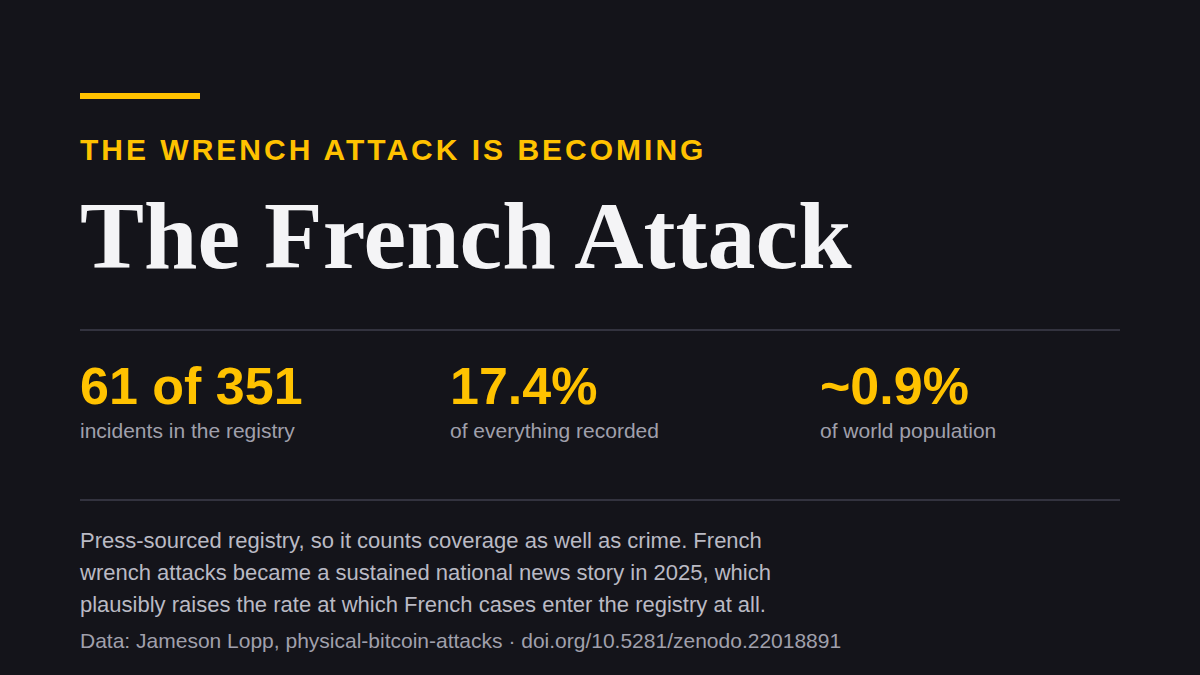
And here's what has to travel with that line. It's a claim about what gets recorded at least as much as a claim about what happens. The registry is built from press reports. French wrench attacks became a sustained national news story in 2025, which plausibly raises the rate at which French cases enter the registry at all, independently of how many occur. A country whose press covers this intensely looks worse than one whose press doesn't, and some of that gap is journalism rather than crime.
What the data can't settle
So France dominates what's recorded. How much is incidence and how much is visibility is exactly the question someone with non-public French data could answer and this dataset can't. If that's you, I'd like to hear from you.
What isn't in doubt is the shape. Organized crews, reconnaissance, targets picked off lists, including here a list the state was keeping because the law told it to.
The counsel says keep a low profile. The law says declare your gains. Pick one.
The file says it already knows.
Two papers sit behind this. The Denial Spiral classifies the defenses that rest on an attacker's ignorance, and shows why the advice gets worse for everyone the more people follow it. The Deadly Race is what it costs you when one of them fails: a seizure that leaves a feasible-but-unfinished path turns a robbery into a race, and prices your elimination. Both free, no signup.
Incident data from Jameson Lopp's registry, a press-sourced sample: it misses the unreported and over-weights whatever made the news. New cases I find go upstream there rather than into a database of mine, which in a post about databases seems worth saying out loud.
If this was worth your time. Send it to someone who still thinks silence is a plan. A ⭐ on Great Wall, the research or these posts costs nothing and makes the work easier to find. And if you want to fund it, support takes ⚡ Lightning and on-chain, no signup, no tiers, nothing expected back.