
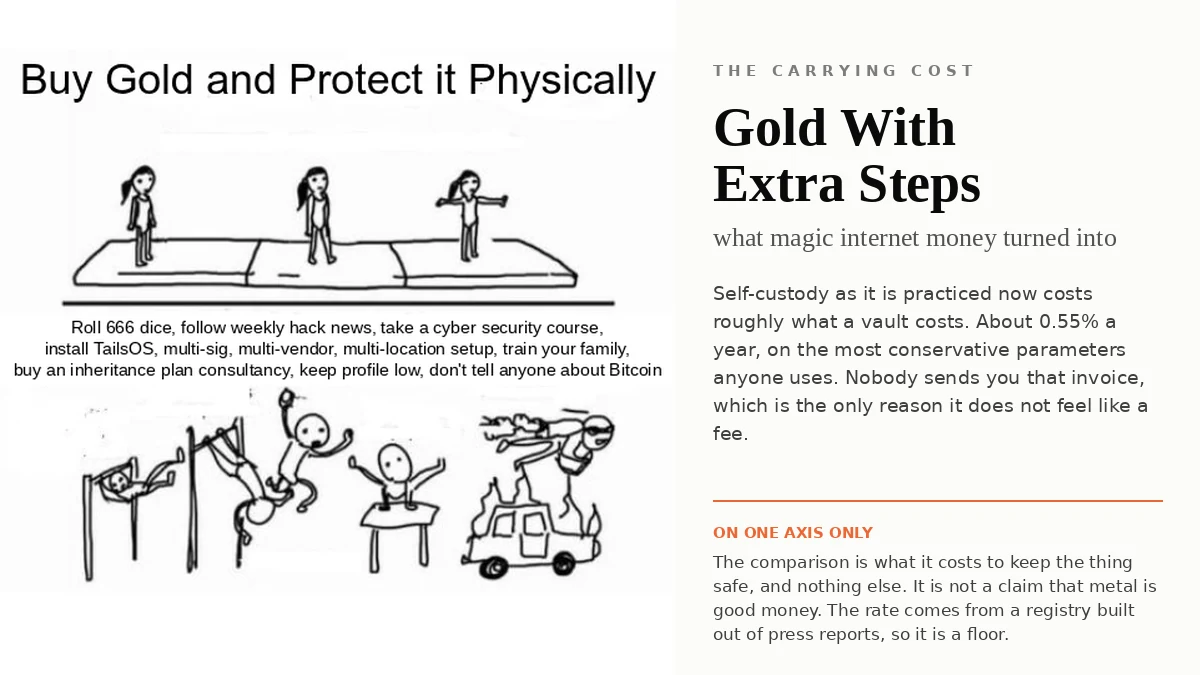
Think about what self-custody actually asks of you now.
Roll dice, because you don't trust a device's entropy. Stamp the words into steel, because paper burns. Never say the word bitcoin at a dinner party. Keep a second wallet with a plausible balance, in case someone asks you at knifepoint. Read every hack post-mortem, in case it's your firmware this time.
That's not a monetary system. That's a security regime, and security regimes have prices.
Somebody already worked out the price
Insurers have been putting a number on "portable, valuable, and stealable" for about two centuries. Jewelry, watches, collectible cars. Six independent sources converge on the same figure: 1 to 2 percent of appraised value per year in the United States, with the pure premium net of admin loading around 0.9 percent.
That's the market's own estimate of what physical vulnerability costs, and it's not a guess. It's priced by people who lose money when they get it wrong.
You can run bitcoin through the same machinery. Take the wrench-attack rate against individual holders, scale it by the insurance industry's own coefficient for crime rate to premium, and adjust for the two ways a wrench attack is worse than a burglary: it usually takes the whole wallet rather than some of the jewelry, and you can't insure it, so you carry the tail yourself.
I get about 0.55 percent a year for individual holders above $100K, on 2026's pace as of the August registry snapshot.
Institutional gold storage runs 0.5 to 1.5 percent.
Where that number comes from, and what's wrong with it
The rate comes from Jameson Lopp's public registry of physical
attacks, coded at commit
9a4a62a: 351 incidents, 1 in 2014, 85 in 2025, 53 in 2026 through mid-August,
which annualises to about 86. Thirteen of those 351 are ATM or crypto-machine
incidents rather than attacks on a holder. Dropping them changes the total to 338
and the recent years barely at all, so I've left them in and told you they're
there.
The registry is built from press reports. It misses everything unreported and over-weights whatever made the news, so the count is a floor with an unknown ceiling. Then a multiplier for underreporting, which I've set at 3, the most conservative value anyone uses. And a severity multiplier of 6, being 3 for total-versus-partial loss times 2 for bearing uninsurable risk.
Both of those are stipulations. Move them and the number moves: at the underreporting estimate the registry's own maintainer thinks is closer to true, it lands north of 2 percent. I'm publishing the low end on purpose. If the conservative number already embarrasses the thesis that self-custody is free, there's no need to argue about the aggressive one.
What that actually means
Bitcoin's pitch was never that it would be cheap to hold. It was that holding it wouldn't require anyone's permission or anyone's building.
Gold's problem was never that gold is bad money. Gold's problem is that a meaningful amount of it has to live somewhere, and somewhere has a landlord, a jurisdiction, and a guard who knows the combination.
So when the cost of holding bitcoin yourself converges on the cost of vaulting metal, something has gone wrong that a price chart won't show you. You're paying gold's carrying cost. You're just paying it in dice rolls, steel plates, silence and vigilance instead of a monthly invoice, which is why nobody experiences it as a fee.
The invoice arrives all at once, to one person, on one bad evening.
The obvious objection
Geography fixes this, and I want to be fair to it, because it genuinely does clear the bar.
Split the keys. Multisig across three countries. A vault in one, a trusted relative in another, a safe deposit box in the third. An attacker at your door now can't finish the job, so the attack doesn't pay.
That works. It also costs money that scales with how well it works — more sites, farther apart, better guarded — and it re-answers the question "is my money safe?" with "how good are my physical defenses?", which is the exact question Bitcoin was supposed to retire.
You've rebuilt the vault. It's just distributed now, and you're the one commuting between the branches.
So buy the metal?
If you've read this far and concluded the sensible move is to hold something physical and guard it properly, I'm not going to pretend that's irrational. Measured against self-custody as it is actually practiced today, it isn't.
Be careful what that concedes, though, because it's narrower than it sounds. I'm not telling you metal is good money, and nothing above argues that it is. The claim is a comparison, on one axis only: what it costs you to keep the thing safe. On that axis the mainstream advice, which is a device in a drawer, words on steel, a rehearsed denial and a wallet kept small enough to hand over, has lost whatever lead it had. The two papers behind this post are about why that advice fails, and neither of them is about gold.
Here, I'll even save you a search: Morgantis Metais. Avelino Morgantis has spent years arguing in Brazilian Bitcoin circles that metal beats magic internet money, and on the specific question of carrying cost he has been right the whole time. That's not a concession I enjoy making and it's not a joke at his expense. It's the argument of this post.
What I dispute is that those are the only two options.
The third thing
Physical distribution clears the bar by making the attack too expensive. Delegated custody clears it by putting the deciding party out of reach, at the cost of the thing being yours. Both work. Both cost you something Bitcoin was meant to give you back.
The route I work on, Great Wall, clears it a different way: the secret isn't on any device and isn't something you could hand over under duress, because it isn't a phrase. So there's nothing at the house worth taking, no guard to pay, no branch to commute to, and no relative holding a piece.
It's a prototype. Don't put savings behind it yet. When that changes it'll be dated in public.
But the reason I'm building it is in the number at the top of this post. A cryptographic problem got solved a long time ago and then quietly turned back into a physical one, and almost nobody is pricing it, because the price doesn't arrive as a bill.
Full model, with every parameter and source: The Security Tax (economic analysis). The threat model behind it is The Deadly Race, with its companion The Denial Spiral. Free, no signup.
Incident data from Lopp's registry
at commit 9a4a62a, coded by a script in the paper's source tree so you can
re-run it and disagree with me precisely. New cases I find go upstream there.
If this was worth your time. Send it to someone who thinks self-custody is free. A ⭐ on Great Wall, the research or these posts costs nothing and makes the work easier to find. And if you want to fund it, support takes ⚡ Lightning and on-chain, no signup, no tiers, nothing expected back.