
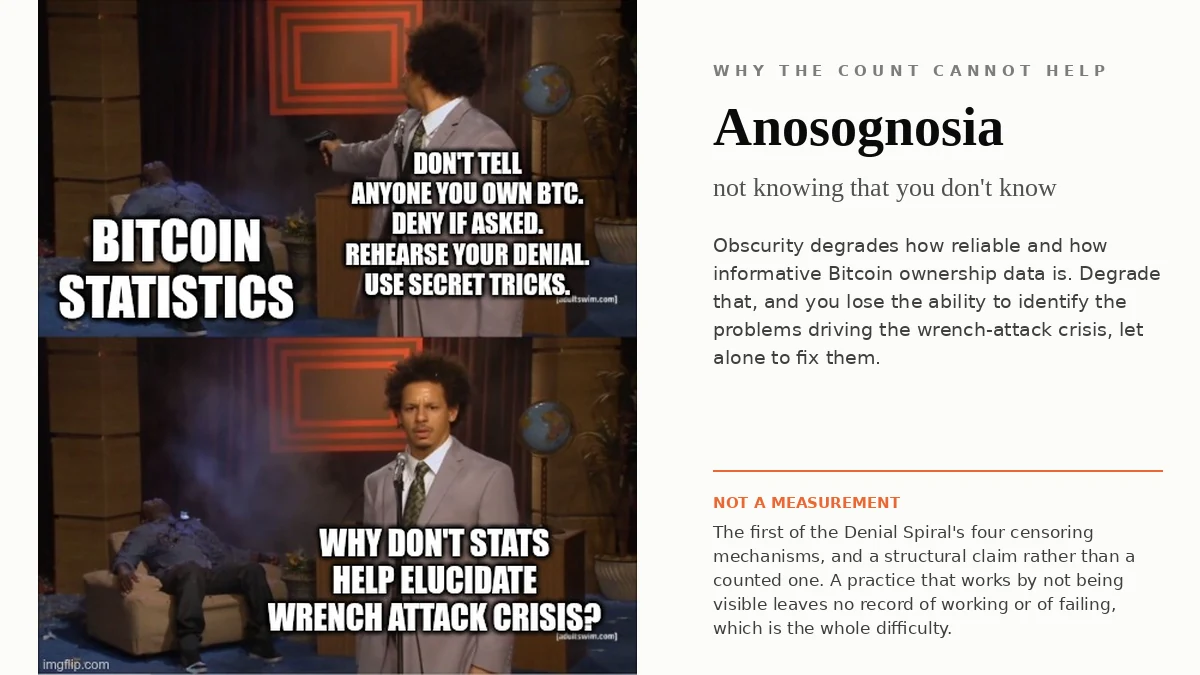
There's a word in neurology for a patient who is ill and can't tell. Joseph Babinski coined it in 1914 for people paralyzed down one side after a stroke who, asked to lift the paralyzed arm, would explain calmly that they didn't feel like it, or that they just had. Anosognosia: not knowing that you don't know. It turns up in Alzheimer's too, and there it's crueller, because the disease erodes memory and, with it, the ability to notice that memory is going. One cause, two effects, and the second hides the first.
I think Bitcoin self-custody has its own anosognosia, and I think it's the reason nothing in this series is likely to change anything on its own.
The disease is obscurity: security that depends on the attacker not knowing something. Decoy wallets, duress PINs, a hidden passphrase, "just don't tell anyone you hold." The earlier posts argued that this fails, that it fails under Kerckhoffs by construction, and that when it fails it can turn a robbery into a torture or a killing. This one is about the anosognosia: why the field can't see it failing. There are four reasons, and the fourth is the one that matters.
One: obscurity does not advertise itself
For obvious reasons, obscurity would typically not advertise itself.
That's the whole of it, and I'd like to leave it there, but it's worth one paragraph on what it costs. No vendor documents a feature as "this works as long as the attacker hasn't read this page." No holder tells a reporter what their backup scheme was. So when someone is abducted, or tortured for a passphrase, or killed, the question was this person relying on something the attacker wasn't supposed to know? has no recorded answer, because nobody ever wrote one down.
So the obvious epidemiological question can't be asked. Doctors find the cause of a disease by asking what the sick have in common. Here the thing the victims might have in common is precisely the thing that is kept secret. That's the first layer of the anosognosia, and it's the one the other three sit on.
Two: a homicide is reported as a homicide
When a holder is killed, the story is a murder. It isn't filed as a robbery whose victim was then eliminated, and the bitcoin often never appears in the coverage at all. So the cases that most directly show what the Deadly Race predicts, a holder killed because their being alive was in the attacker's way, are the cases least likely to be recorded as attacks on holders.
This is the weakest of the four, and it's worth saying why before leaning on it. It pushes the count of deaths down, but a matching silence pushes the other side of the fraction down too. Someone who survives a wrench attack has every reason not to tell the police, let alone a reporter, "I was tortured for my bitcoin," because saying so tells the next crew where to go. So the one number I keep citing, that 4.6% of recorded wrench attacks end in a death (16 of 351 in Jameson Lopp's registry, a press-sourced sample), is missing deaths and missing survivals, and nobody can say which it's missing more of. It might be too low. It might be too high.
I'm keeping it on the list anyway, partly for completeness and partly because what it does to the record is real even where its effect on one ratio washes out: the killings that most directly show what the Deadly Race predicts are the ones least likely to be filed as what they were.
Three: the survivors were not told either
You'd think the first two could be worked around. If the victim is dead, ask the family what they were running.
This is where it gets properly bleak. A scheme that depended on the attacker not knowing depended on the holder not telling, and discretion isn't selective. The family wasn't told either. That was the point.
And where they do know, telling costs them. Saying publicly that the victim held bitcoin announces that someone in the house may hold it now, very often the person saying it. So it gets withheld unless it might help catch someone. The one person who could have answered the question is the one the theory predicts won't survive to be asked, and the people left are the ones with the least information and the most reason to keep what they have.
So: what the victims were running is censored by what vendors don't say. How often the worst outcome happens is blurred by how it gets classified, in both directions at once. And what's left is censored by what the bereaved don't know or won't repeat. The part of the record that could tell you which designs get people hurt is exactly the part that's missing. The disease has taken the evidence of the disease, which is anosognosia in the strict, clinical sense.
Four: conceding is expensive to whoever concedes
The first three remove evidence. This one removes the response to evidence, and it's the part of the anosognosia that survives being diagnosed, which is why writing this post doesn't dissolve it.
Suppose you accept the argument. What have you just said? If you're a vendor, that a feature you shipped is worse than not having it, about devices already in customers' hands. If you're a trainer, that the coached denial you sold drains the credibility of everyone's denials. If you're a holder, that the setup you're still running is the dangerous kind. The cost of agreeing is private, immediate, and yours. The cost of not agreeing is spread across holders you'll never meet, arrives later, and has no name attached.
That's the same shape as the problem in the Denial Spiral, one level up. There, the shared resource being drained is how believable a denial is. Here it's the field's ability to correct itself. In both, the sensible move for each individual is to wait for someone else to go first. Stubbornness is cheapest exactly where it's most expensive for everyone.
I should be careful about what this does and doesn't claim, because a theory that predicts silence can be abused. It would be easy, and wrong, to read every vendor who doesn't reply as secretly agreeing. People don't reply for ordinary reasons: time, lawyers, disagreement they never wrote down. Nothing here licenses a conclusion about any one of them. The prediction is about the aggregate: that the analysis being available won't, by itself, get it adopted, and that it'll be adopted first wherever conceding is made cheap. A neutral name for the weakness. A reviewed paper to cite. A bar that was set before anyone was measured against it.
Vienna, 1847
Everyone reaches for Semmelweis here, and it's worth doing properly, because the gesture version is a cliché and the real version is more useful.
In 1847 Ignaz Semmelweis was working in a maternity clinic in Vienna where women were dying of childbed fever at a rate the midwives' clinic next door didn't have. That spring his colleague Jakob Kolletschka cut himself with a scalpel during an autopsy, and died of what looked exactly like childbed fever. Semmelweis put it together: the doctors were coming straight from the dissecting room to the delivery ward and carrying something on their hands. He made them wash in chlorinated lime. Mortality in his clinic fell from roughly 18% to roughly 2% within the year.
He was right two decades before germ theory could explain why, and he was rejected anyway. Not only on the evidence, which was strong. On position. The profession's anosognosia had a very specific shape: accepting it meant accepting that physicians' own hands had been killing their patients. That's mechanism four exactly, and it's the only part of the analogy I'll claim.
There's a second lesson in the story, and it cuts against me, so I'll take it. When his book failed to persuade, Semmelweis started writing open letters calling his critics murderers. It didn't help. What eventually changed practice was Pasteur and Lister, twenty years on, giving the profession a way to agree without having to confess, and the delay was counted in dead women. That's why the Denial Spiral states a bar instead of an indictment, classifies designs instead of people, and credits vendors where the record credits them. Being right loudly is not the same as being right usefully.
What kind of claim this is
At this point a fair reader asks: if every source of evidence is censored, isn't this unfalsifiable? A theory that explains away its own lack of evidence is usually a bad sign, and a theory of anosognosia is exactly the kind that could.
It would be, if it were a claim about frequency. This is a claim about structure, derived from what a rational attacker does given what he can and can't know, in the way you can derive that a price ceiling produces queues without counting any queues. No dataset could confirm it or refute it, and the reason is internal to the subject: the only witnesses to an enacted case are an attacker with every reason to deny the motive and a holder, or a family, with every reason to deny the asset. Asking them isn't a weak instrument. It's no instrument at all.
What it can be tested against is its own logic, and there are two specific ways to break it. Show a setup where, after the attacker has the holder and everything they carry, a path to the coins still exists but finishing it gives the attacker no reason to want the holder gone. Or show that the attacker the papers assume is, in some way that matters, weaker than a real one. Neither needs a victim or a survey. Both are settled by reading the argument, and either would sink it.
That's also why the papers end in a bar rather than a finding. Whether a design leaves the holder as the last obstacle between an attacker and the money is decided by reading the design. It doesn't wait on the data, and it's just as well, because the data is not coming.
Publishing anyway
So why write any of this, if the fourth mechanism says it won't work? Because anosognosia in a field behaves differently from anosognosia in a brain.
The fourth mechanism is about cost, and cost can be moved. It predicts that nobody wants to go first. It says nothing against making going first cheaper: a named weakness class that isn't anyone's fault, a published criterion you can apply to your own setup without anyone watching, papers with DOIs that a vendor can cite as the reason for a change instead of admitting a mistake. That's what this series has been trying to build. The only move the fourth mechanism doesn't already price is to lay the argument out in public and keep it there.
I should say where I stand in this. I sell security audits built on these arguments, and the Great Wall project I work on is one answer to the bar the Deadly Race sets. That's an interest, and you should weigh what I've written with it in mind. I'd rather tell you than have you find it.
If you hold, the test is short and nobody has to see you take it. Suppose someone has you, everything you carry, and a copy of your setup's manual. Is there still a path to the bulk that only you can finish, given enough time? If the honest answer is "yes, eventually," that path is what the Deadly Race is about, and it only ever looked safe because nobody knew about it. You now know about it.
The four mechanisms, Semmelweis and the argument about what kind of claim this is are in The Denial Spiral. The criterion is in The Deadly Race. Both open access, no signup.
Incident data from Jameson Lopp's registry, a press-sourced sample: it misses what goes unreported and over-weights what made the news. New cases I find go there rather than into a dataset of mine.
If this was worth your time. Send it to whoever talked you into your current setup. A ⭐ on Great Wall, the research or these posts costs nothing and makes the work easier to find. And if you want to fund it, support takes ⚡ Lightning and on-chain, no signup, no tiers, nothing expected back.